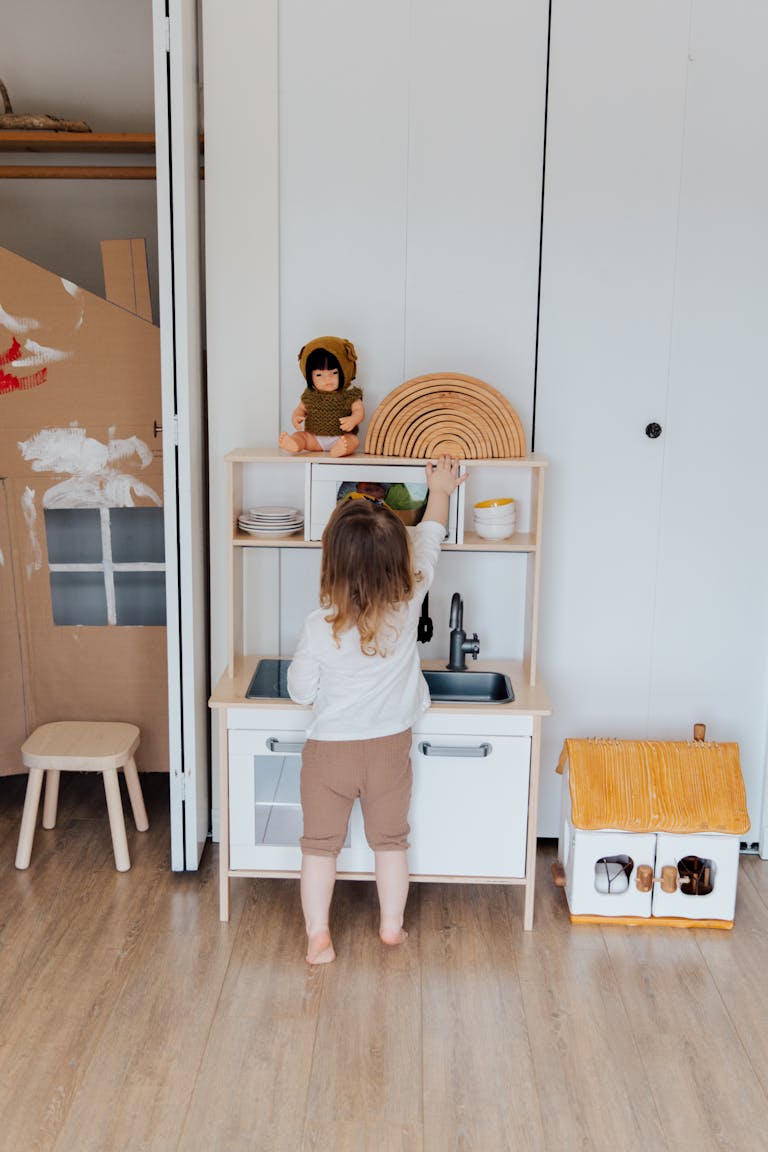

Frustrated With Baffling Toddler Behavior? Try This Simple Four Step Process to Crack the Code and Bring Back Calm and Connection
Deep in the trenches of toddler mom life, understanding your two-year -old’s tantrums and destructive habits can feel like a mind melting exercise in futility.
In this post I am going to teach you the exact process child development experts use to decode baffling toddler behaviors.
If parenting your little one currently feels like parenting a mysterious, very loud creature from another world and you just want to get on the same page again, read on.

All behavior is communication.
When your child was a baby, their communication with you was rather simple. It consisted of grunting, fussing, or crying when hungry, tired, wet, too hot, or too cold; coos, relaxed body posture, eye contact, and eventually little smiles and giggles when content and happy; they might have averted their gaze when overstimulated, pulled on their ears at naptime, or sucked on their fingers to let you know they were ready for more milk.
Now that your baby has entered the toddler stage, communication has likely expanded to include some expressive language (“Me do!” “Want that!”), physically moving their own body towards or away from things or people, and a whole array of facial expressions that correspond not just with physical needs but emotional states as well.
Some of these may be fairly straightforward to understand, but others can be quite confusing. What on earth is my 20 month old communicating by dumping out every single toy she owns onto the floor? What about collapsing in a fit of screams and tears that lasts for what feels like an hour for no discernable reason? Why is the entire roll of toilet paper once again completely unraveled into the toilet in 3.2 seconds flat?
Believe it or not, these behaviors are communication too. The language of behavior isn’t always totally intuitive, but once you understand the basic “grammar” of behavior, you can make sense of even seemingly senseless behaviors.
Very young children have only just begun to acquire expressive (verbal) language. At the same time, around 10-12 months they begin to develop needs that the did not previously have. In addition to the basic survival needs they have been communicating with you since birth (food, sleep, connection, cleanliness, etc.) your child now needs things like: even more physical freedom of movement than they needed in infancy, personal autonomy, increased sensory stimulation, and cognitive challenges to help their brains continue to develop.
Toddlerhood is a tricky in-between stage where all at once our babies go from being able to communicate their basic needs with entirely non-verbal methods, to now not only being increasingly expected to communicate those needs verbally, but also having entirely new, very intense needs that they have never had to communicate before and therefore need a whole new language to express. This combination of emerging but not quite fluent verbal skills mixed with a brand new set of needs leads to the classic “terrible twos” behaviors we are all too familiar with: tantrums, destruction, aggression, etc.
The Behavior-Attachment Pipeline

Toddlers do not have the cognitive capacity to fully speak our grown up language with the same level of fluency that we do. It is up to us as adults to become fluent in their language and gradually teach them to communicate in ways that are acceptable and appropriate. While they are learning, they need immense patience and empathy from us. Toddler behaviors can be maddening for adults; but remember that it is just as maddening for them to have all of these new needs and to have no idea how to express them, much less how to express them in ways that other people find palatable.
Our children need to feel attached to us, but we also need to feel attached and connected to them. Toddler behavior makes those warm fuzzy feelings somewhat more challenging to find. It can feel like our once intuitive framework for understanding our baby’s needs suddenly doesn’t seem to work anymore. When we learn to speak our toddlers’ language, we can finally feel connected and in tune with them again. Those feelings of connection and attunement not only benefit our children; they are what enable us as caregivers to remain present, peaceful, and sane in the midst of our children’s sometimes stormy behaviors and moods.
Four Steps to Become a Bona Fide Toddler Whisperer
To crack the code on toddler behavior and build those strong, steady connections with them, child development experts follow four steps:
- Observe the behavior. Get objective about what is happening before, during, and after the behavior. At this stage, we refrain from making any judgements about what we think the behavior means and only look at the cold, hard facts. What do we see with our eyes and hear with our ears before this behavior happens, while it is happening, and after it concludes?
- Interpret observations. After we have gathered the objective facts, we look them over and try to make meaning of what we are seeing. Like scientists, we make a hypothesis: “I think x behavior was an attempt to communicate y.”
- Intervene (respond) based on our interpretations. This is the step most people mistakenly try to do first. This is when we jot down 1-3 ideas of what our child might need from us before, during and after this behavior next time, and we give it a try! We test our hypothesis.
- Repeat! We repeat steps 1-3 above until we feel good about how the behavior is going – perhaps our child gains more appropriate skills to communicate this need, or finds a healthier outlet, or we learn how to respond in a way that moves the interaction along in a positive way. Then we move on to a new behavior, and repeat the whole process again.
A Couple Mistakes to Avoid When Learning to Speak Toddler-Ese
Becoming an expert in your child’s behavior has a little bit of a learning curve. Here are some tips to help you avoid the most common pitfalls.
Observations are objective; interpretations are subjective.
In Step 1 of the behavior analysis process (above), it is important to remain completely objective. This is challenging when we are observing our own children! But setting aside our interpretations of their behavior temporarily puts us in a brain space that is open to new ideas and interpretations. Clinging on to a specific meaning of a behavior too soon can lock us out of interpretations that might actually be closer to the truth.
One trick that really helps with this is to jot down your observations on a physical piece of paper with two columns. On one side write down your objective observations – just the facts: we walked in the door after our walk, Johnny took 3 steps then used left hand to pull 7 pairs of shoes off of the shoe shelf. Johnny was laughing and screeching while doing this. When all the shoes were on the floor he walked 10 steps to his train table and began playing there, pushing the train cars 1 by one off the edge of the table.
On the other side of your paper you can jot down any interpretations that come to your mind: he seems happy, he wanted to make a mess, he likes the feeling of knocking things over.
It’s okay to even write down interpretations that you are pretty sure aren’t true but feel true in the moment: he hates me, he wants me to have to clean all this up, he is destructive for destruction’s sake. We know those emotional interpretations probably aren’t aligned fully with reality, but having permission to just get them out on paper can really help us to let them go, or to find the kernel of truth in them.
Toddlers are not mini-adults.
When it is time to interpret your observations, do not make the mistake of interpreting toddler behavior through the lens of appropriate adult behavior. Remember: your child’s brain is physically not the same as an adults, or even an older child.
Getting a basic familiarity with stages of development can really give you a lot of context when it comes to making meaning out of behaviors that seem totally nonsensical from an adult lens.
If you are starting from 0 and have no knowledge of child development at all – don’t worry! We all start somewhere, and child development is not difficult to learn. To interpret most of a typically-developing toddler’s behaviors, you’ll really benefit from having a cursory knowledge of:
- Maslow’s Hierarchy of Needs
- Erikson’s Stages of Development
- Piaget’s Play Schemas
- Dreikur’s Four Goals of Behavior
Having a basic familiarity with these four frameworks will give you lots to work with when trying to figure out the meaning behind your toddler’s behavior.
Remember: Jesus is the ultimate behavior expert, and He knows your child perfectly.
It is totally normal as moms to sometimes come up against behaviors with our children that are just completely puzzling to us.
When you are truly stumped, don’t forget to ask Jesus for wisdom and insight. Invite him in to your process of observation, interpretation, and intervention. Calling upon His perfect knowledge can truly be a gamechanger. If nothing else, approaching behavior prayerfully changes you, putting your heart in a receptive, humble posture, ready to learn and receive.
Need more support with navigating toddler behavior?
If you want to learn more about how to understand your toddler’s “language” of behavior, and how to respond in ways that resonate with them, I am working on something really exciting for you.
My Toddler Behavior Starter Pack will be coming out in February 2026! This guide to toddler behavior has everything you need to observe objectively, interpret intelligently, and intervene appropriately. You’ll get a behavior dictionary that helps you translate common toddler behaviors into possible meanings based on child development research; a behavior toolkit with my top most useful strategies for responding to toddler behaviors in a positive way that nourishes healthy attachment; scripts you can steal word for word; and more.
If you want to be the first to know when the Toddler Behavior Starter Pack goes live, make sure you get on my email list! Subscribers will get access before anyone else.
Are you puzzled by a particular toddler behavior right now? Drop it in the comments and we can workshop it together!